
In my studio, form is never static. It bends, breathes, and fragments—echoing the emotional architecture of the women I draw. Soft Cubism is one of the core themes that shapes my practice. It’s a visual language born from contradiction: geometric yet tender, structured yet emotionally porous. Through this theme, I explore how identity, memory, and presence can be distilled into softened shapes and tonal nuance.
For collectors, stylists, and curators, Soft Cubism offers a way to bring emotional depth into minimalist interiors. These works speak in whispers—inviting quiet reflection, subtle tension, and the beauty of imperfection.
What is Soft Cubism?
“Soft Cubism” is not a formal movement with a fixed definition in art history—it’s a contemporary interpretation that blends Cubist principles with emotional nuance, often used by artists like myself to describe a gentler, more introspective approach to abstraction.
Working Definition of Soft Cubism
Soft Cubism is a style of contemporary art that reimagines the fragmented geometry of traditional Cubism through a more fluid, emotionally resonant lens. It typically features:
- Abstracted figurative forms softened into curves and tonal gradients
- Monochromatic or muted palettes that evoke mood and memory
- Layered presence where emotional depth replaces rigid structure
- Negative space and incompletion as intentional compositional tools
- A focus on emotional realism rather than analytical dissection
Unlike historical Cubism—which emphasized multiple viewpoints and formal structure—Soft Cubism leans into ambiguity, presence, and the poetics of fragmentation. It’s often used to explore identity, memory, and the tension between visibility and silence.
Bridge to a Comparison
If you’re curious how Soft Cubism sits alongside historical Cubism and interwar geometric stylings, I’ve written a companion piece comparing Picasso and Tamara de Lempicka—and what those differences mean for my practice.
Read the comparison here: Why Picasso and Lempicka Matter to Soft Cubism
Visual Language: Form, Tone, and Texture
Each Soft Cubist drawing begins with a gesture—a line that curves, hesitates, or loops back on itself. I build from there, layering graphite, charcoal, or ink to create tonal depth. The goal is not realism, but emotional resonance.
Key elements include:
- Fragmented geometry: Forms are abstracted into planes and curves, suggesting rather than defining
- Tonal nuance: Greyscale gradients evoke mood, memory, and atmosphere
- Negative space: Silence is part of the composition. What’s left unsaid becomes part of the story
These works often feel unfinished—and that’s intentional. I believe in the poetry of incompletion. It invites the viewer to participate, to fill in the emotional gaps with their own experience.
Emotional Themes within Soft Cubism
Soft Cubism is not just a style—it’s a vessel for recurring emotional themes in my practice. These include:
1. Presence and Absence
Many pieces explore the tension between being seen and being invisible. A face may be partially obscured, a gaze turned away. This reflects the emotional complexity of womanhood—how we navigate visibility, vulnerability, and self-containment.
2. Memory and Fragmentation
The fragmented forms echo how memory works: non-linear, partial, emotionally charged. These pieces often feel like visual echoes—moments suspended in time, incomplete but resonant.
3. Identity and Cultural Inheritance
As an Anglo-Indian artist, I often reflect on cultural nuance and inherited silence. Soft Cubism allows me to abstract identity without erasing it—to explore how form and emotion intersect across cultural lines.
Studio Process: Cyclical Thinking and Emotional Anchors
My workflow is adaptive and cyclical. I rarely work in straight lines. Instead, I move between pieces, returning to them like emotional landmarks. Soft Cubism thrives in this rhythm.
I use:
- Sensory anchors: Music, light, and scent to evoke emotional states
- Micro-goals: Small, achievable steps that allow me to build momentum
- Fragmentation as method: I often begin with isolated features—a mouth, a brow—and build outward
This process mirrors the theme itself: fragmented, recursive, emotionally attuned.
Some of my Featured Works in Soft Cubism

MIA – A young woman with vibrant red hair is depicted from the back, adjusting her white top against a moody, dark background. The contrasting colors emphasize the figure’s form and movement. View in the print store
 Mia en Noir – A young woman is depicted from behind, with long hair cascading over her shoulders. The lighting emphasizes the contours of the back and shoulders, creating a dramatic effect. View in the print store

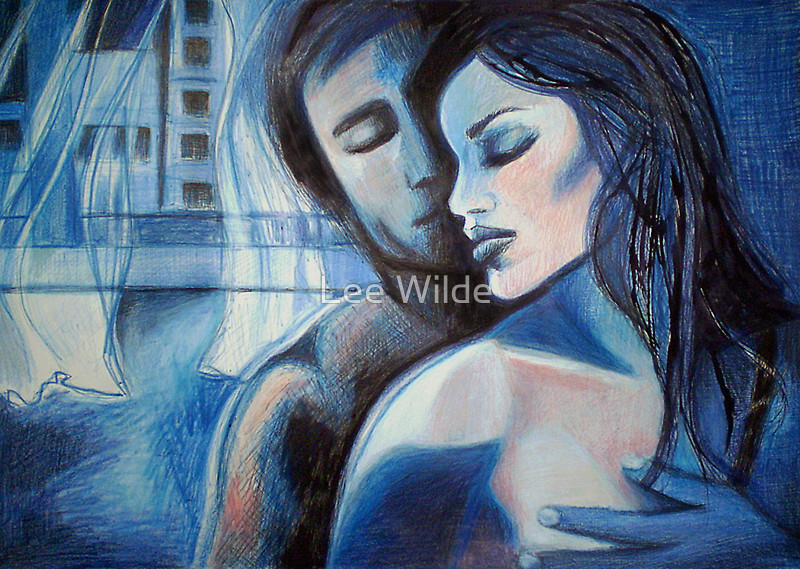
Blue – A couple is embracing in a tender moment, depicted in shades of blue that convey a sense of calm and intimacy. The background features abstract forms resembling building structures and flowing curtains. View in the print store
Designers and Collectors
Soft Cubist works are popular among collectors who value emotional depth and minimalist design. They pair well with:
- Neutral interiors: Greys, whites, and natural textures
- Eclectic spaces: Where emotional resonance is layered with personal artifacts
- Stylistic contrasts: Soft Cubism adds warmth and tension to modern, industrial, or Scandinavian aesthetics
Collectors often describe these works as “quietly powerful”—they don’t shout, but they stay with you.
Soft Cubism Softens the Geometry of Contemporary Interiors
Soft cubism takes the fractured language of early cubism and dissolves its edges, allowing geometry to feel warm, human, and quietly expressive. Instead of hard planes and analytical structure, the style leans into softened contours, diffused colour fields, and shapes that feel more like memory than mathematics.
In contemporary interiors, this approach works as it introduces structure without severity. The geometry gives a room rhythm, but the softened forms keep the atmosphere calm and open. It is a style that holds both order and emotion — a balance that suits modern spaces seeking visual interest without noise.
Reflections: Why Softness Matters
In a world that often demands clarity, completion, and spectacle, I choose softness. I choose ambiguity. I choose emotional nuance.
Soft Cubism is my way of resisting the binary—of saying that identity, emotion, and presence are not fixed points. They are fragments. They are echoes. They are soft.
For me, this theme is not just visual—it’s philosophical. It’s how I move through the world.
The Still Center of Motion
Soft Cubism is the still center of my creative motion. It’s where geometry meets emotion, where form dissolves into feeling. These works are not just portraits—they are emotional maps, fragments of memory, and invitations to presence.
Thank you for stepping into this theme with me. I hope it lingers.
🔗 Read more:
- About Me – Learn more about my neurodivergent process and emotional realism.
- Art Theory: Understanding the Ideas That Shape Contemporary Art
- Print Shop – Soft Cubism – Browse available works in this theme.