
Some artworks don’t simply decorate a room — they inhabit it, shaping the emotional temperature of a space and echoing the quiet rhythms of memory. Wall art that speaks to memory and emotion has a way of settling into the interior like a presence, not an object. It becomes part of the room’s atmosphere, part of the viewer’s inner life, part of the story a home tells about the people who live within it.
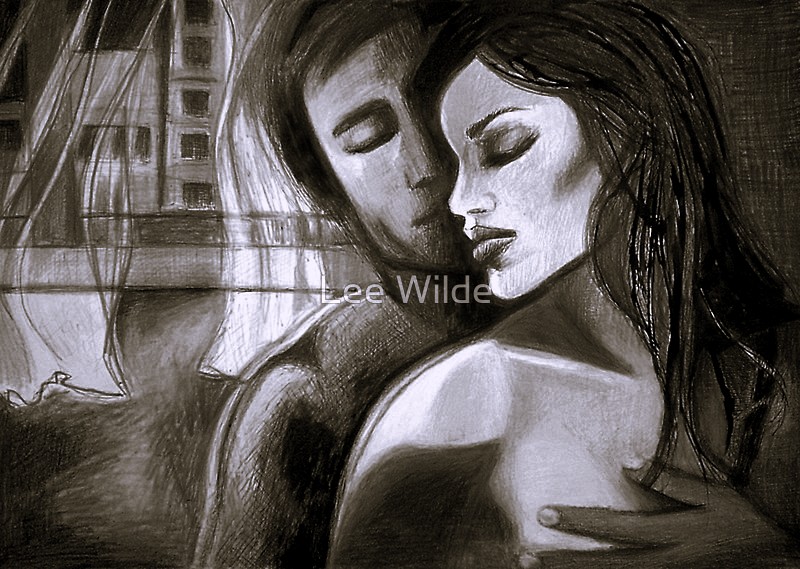
In Glenferrie Road (pictured above), two lovers stand quietly in a darkened room, their posture suspended between vulnerability and resolve. Behind them, buildings loom softly, half‑veiled by curtains that seem to breathe with memory and soften the edges of time. The monochromatic palette — rich in graphite and shadow — invites stillness, where the city’s hum fades and personal history quietly takes shape.
Glenferrie Road is available as a fine art print
This piece is a perfect example of how wall art can become a vessel for memory and emotion, inviting stillness and reflection into our everyday spaces.
 Mia en Noir by Lee Wilde 2008
The Emotional Weight of Quiet Imagery in Wall Art
Quiet imagery has a way of holding emotional gravity. Black‑and‑white drawings, especially those rendered in graphite or charcoal, create a kind of visual hush. Their restraint allows space for projection — for viewers to bring their own stories to the surface.
A softly smudged contour can evoke longing.
A vacant gaze can stir tenderness.
A blurred edge can recall grief or nostalgia.
This is why emotionally resonant wall art often feels like a mirror turned inward. It doesn’t overwhelm the room; it deepens it.
For readers interested in the history of portraiture and emotional expression, the Tate offers an excellent overview of portrait traditions and their psychological impact (see Tate’s portraiture resources). And for a broader look at how artists use realism to convey emotional truth, MoMA’s learning pages on contemporary realism provide helpful context.
Memory as Medium: How Wall Art Holds the Past
When I create or curate wall art, I often think of memory not just as subject matter, but as medium. The textures of conté, the grain of paper, the softness of charcoal — these materials feel like time itself: layered, imperfect, deeply personal.
Memory is rarely sharp.
It is smudged, softened, reinterpreted.
The best wall art doesn’t simply depict a moment; it remembers it.
This is why certain artworks feel like they’ve always belonged in a room. They resonate with the viewer’s own emotional archive, even if the subject is unfamiliar. They whisper rather than shout, and in that whisper, they recall.

Placement as Emotional Invitation: Where Wall Art Lives in a Room
Where a piece is placed matters — sometimes more than the piece itself.
A drawing hung beside a window might catch the morning light and shift in tone throughout the day, echoing the way memory itself changes with time. A portrait placed in a hallway becomes a companion in passing — a quiet presence that anchors the space. In bedrooms or reading corners, wall art becomes part of the room’s emotional architecture, shaping how the space feels, not just how it looks.
This is the essence of The Feminine Interior: spaces shaped by softness, memory, atmosphere, and emotional resonance.
The Viewer as Co‑Author: How Emotionally Resonant Wall Art Invites Interpretation
Emotionally rich wall art doesn’t dictate meaning; it opens a door.
- A figure turned away
- A blurred horizon
- A moment suspended
These elements invite the viewer to step inside the artwork and complete the emotional narrative themselves. The viewer becomes a co‑author, bringing their own memories, desires, and interpretations to the piece.
This is why certain artworks feel intimate even when the subject is a stranger. The emotional realism of the piece creates a shared interiority — a quiet space where the viewer’s inner world meets the artist’s.
Wall Art That Speaks to Memory and Emotion in the Home
Wall art that speaks to memory and emotion doesn’t demand attention — it earns it. It becomes part of the rhythm of a space, part of the rhythm of a life.
Whether you’re drawn to figurative sketches, atmospheric drawings, or abstract impressions, the pieces that linger are often the ones that feel like they’ve always been there — waiting to be seen.
This is the heart of The Feminine Interior:
art that shapes the emotional architecture of a room, art that holds space for reflection, art that feels like a companion.