

Some artworks don’t offer answers—they ask questions. Philosophical wall art invites us to pause, reflect, and reconsider what we think we know. Whether through mythic symbolism, abstract distortion, or quiet emotional tension, these pieces become portals—visual spaces where thought and feeling converge. In this post, I explore how wall art can serve as a philosophical companion, shaping not just our interiors, but our inner lives.
Art as Inquiry
Philosophical wall art often begins with ambiguity. A figure turned away, a fragmented silhouette, or a shadow that refuses to resolve—these elements provoke thought. They resist easy interpretation, inviting the viewer to engage intellectually and emotionally. In my own work, I often use posture and negative space to suggest questions about identity, memory, and perception.
The Centre Pompidou frequently showcases artists who use visual form to explore existential themes. Their curatorial approach reminds us that art can be a site of inquiry, not just expression.
Symbolism and Layered Meaning
Symbolism is central to philosophical wall art. A curtain may represent concealment or revelation. A blurred edge might suggest impermanence. These visual metaphors allow viewers to project their own interpretations, making each encounter personal and dynamic.
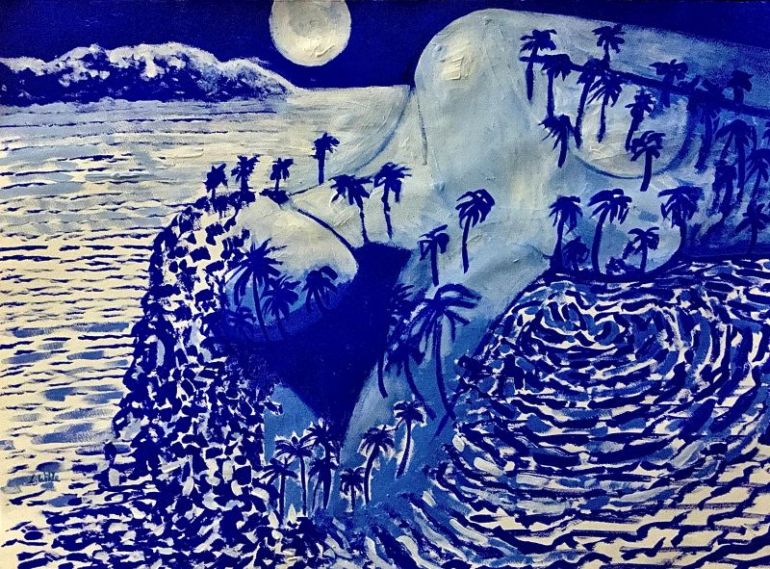
In the case of Bay of Dreams, its surreal coastal landscape, swirling water, and moonlit glow evoke a dream-state that invites reflection on time, memory, and the boundary between reality and imagination. Here’s why it reads as philosophical:
- Symbolic Elements: The full moon, swirling bay, and scattered palms suggest cycles, impermanence, and solitude—classic philosophical motifs.
- Atmospheric Ambiguity: The ethereal palette and surreal composition resist literal interpretation, encouraging emotional and intellectual projection.
- Spatial Metaphor: Bays are liminal spaces—neither land nor sea, containment nor openness. This ambiguity mirrors philosophical inquiry itself.
It’s a piece that doesn’t just depict a place—it evokes a state of mind. Would you like me to help integrate Bay of Dreams into the philosophical wall art post, or write a standalone reflection around it?
Consider how The Metropolitan Museum of Art presents works that engage with myth, time, and abstraction. Their collections show how symbolic imagery can transcend cultural boundaries and speak to universal questions.
To live with philosophical wall art is to live with questions.
Emotional Depth Through Abstraction
Philosophical wall art often balances abstraction with emotional resonance. A distorted figure may evoke disconnection, while a soft gaze might suggest longing. These emotional cues, when paired with symbolic ambiguity, create a layered experience—one that unfolds slowly over time.
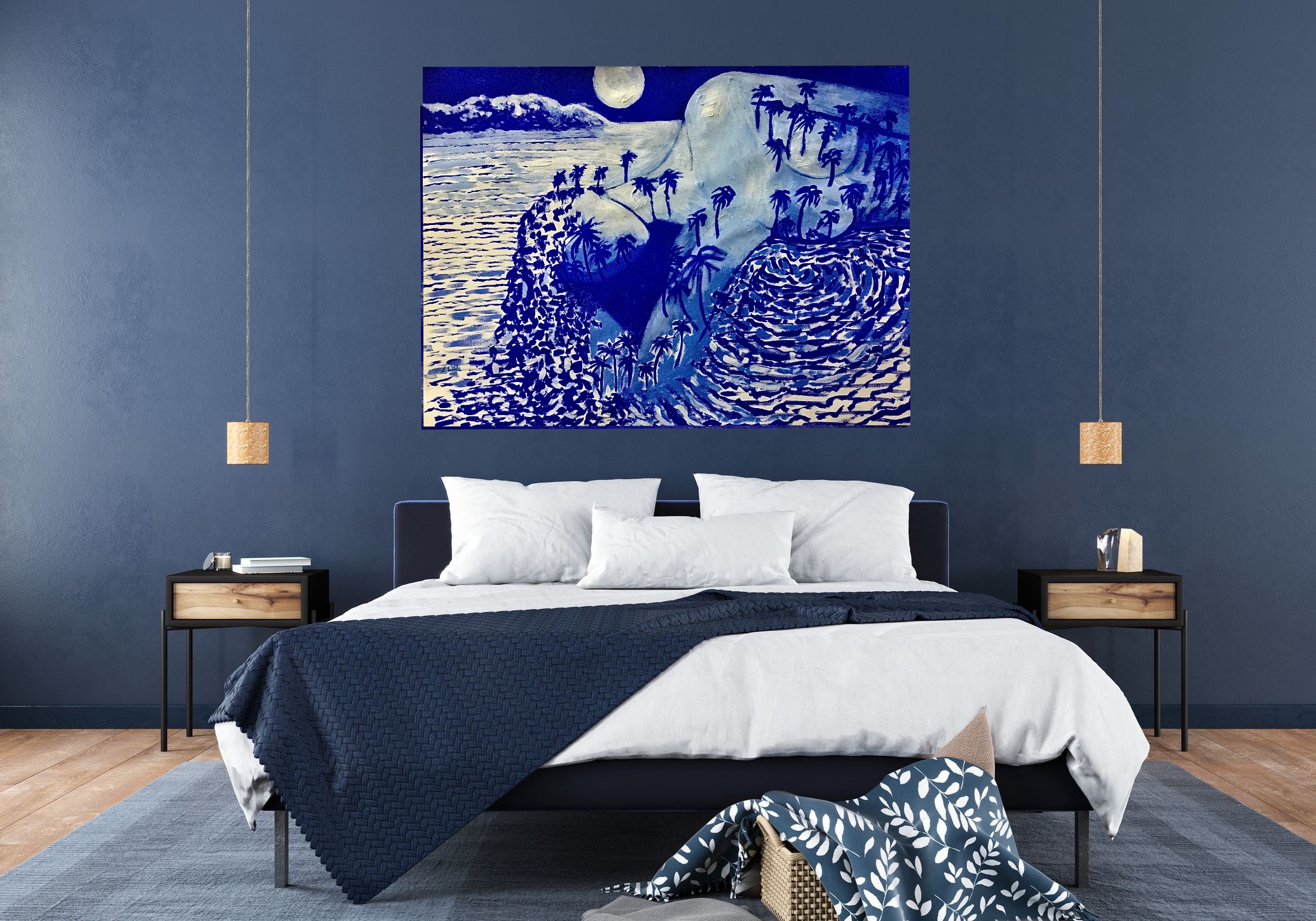 Bay of Dreams insitu
Living with Thoughtful Art
To live with philosophical wall art is to live with questions. These pieces don’t demand attention—they reward it. Hung in quiet spaces, they become companions for thought, offering a kind of visual meditation. They remind us that beauty can be complex, and that complexity can be beautiful.
Whether placed in a study, hallway, or bedroom, philosophical art transforms a space into a site of reflection. It’s not just about what you see—it’s about what you begin to feel and consider.
Philosophical wall art opens doors—not just to aesthetic pleasure, but to deeper thought and emotional engagement. These pieces invite us to slow down, to ask, to feel. If you’re drawn to art that lingers in the mind long after the eye has moved on, explore the collection or reflect on what questions your walls might be ready to ask.