


One of my favourite artworks at the Art Gallery of NSW is this deceptively simple painting, Self Portrait by Pierre Bonnard, circa 1938 – 1940, located in the 19th and 20th century European galleries on the ground floor. In a room containing the huge and ultra-weird Nude in a Rocking Chair by Picasso, a dreamlike Cezanne and fleshy, crowd-pulling Lucian Freud, the small Bonnard hangs beside a doorway, like a shy guest at a party. Shy but not unaware, he has bathed himself in gold light, drawing me in….to his face…his hands.. so quietly yet powerfully beckoning. It’s no wonder he’s known as the Master of intimacy. Every time I see it, it’s like meeting up with an old friend again.
Pierre Bonnard (1867–1947) was a French Post-Impressionist painter and a founding member of Les Nabis, a group of avant-garde artists who sought to blend art with spirituality. Known for his vibrant use of color and his ability to capture the essence of domestic life, Bonnard’s works often reflect a deep emotional resonance.
 Nude in the Bath, Pierre Bonnard (1925)
Bonnard’s partner, Marthe de Méligny, was a recurring muse, appearing in many of his paintings, including the iconic Nude in the Bath (1925), currently held in a private collection.
Intimism Art Movement
Bonnard’s artistry fits into the Intimism movement, which focused on capturing the quiet, personal spaces of everyday life with emotional depth and detail. This movement, pioneered by Bonnard and Édouard Vuillard, centred on domestic interiors, private rituals, and the subtle choreography of light across familiar rooms. Rather than grand narratives or heroic subjects, Intimism elevated the poetry of the everyday—the way morning light falls across a table, the hush of a room at dusk, the presence of a loved one moving through a shared space.
Bonnard’s work embodies the essence of Intimism with remarkable sensitivity. His interiors are not simply rooms; they are emotional environments, shaped by memory, colour, and the shifting temperature of lived experience.
Works such as The Dining Room in the Country (1913), Woman with a Dog (1891), and his many luminous bathroom scenes featuring Marthe—Nude in the Bath (1925), The Bath (1925), Nude in the Bathtub (1931)—extend this intimate gaze. They reveal a world where the boundary between observation and feeling dissolves, where colour becomes a form of emotional notation.
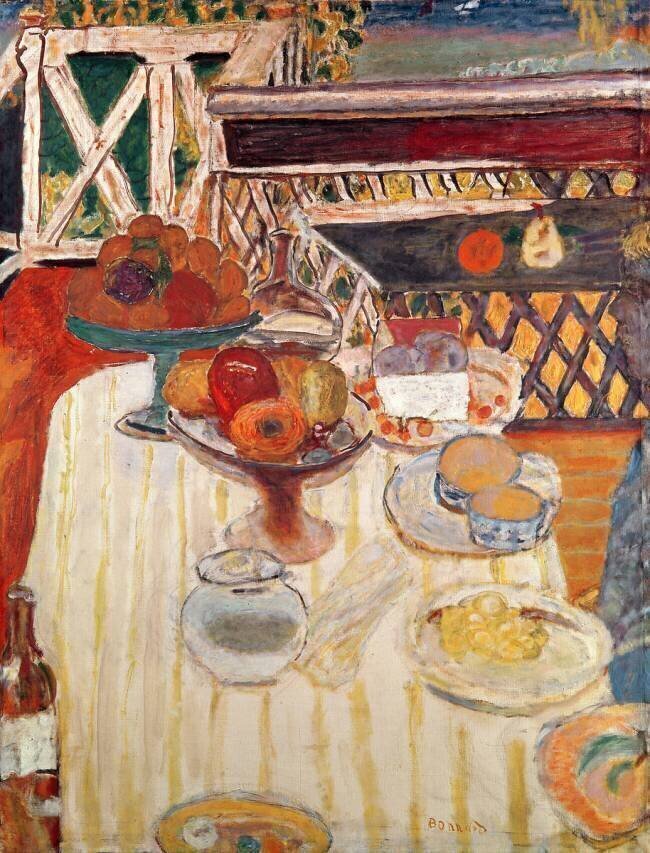 The White Tablecloth (1925) by Pierre Bonnard
Even his still lifes, like The White Tablecloth (1925) or The Table (1926), carry the same quiet electricity. Objects seem to hum with presence, as if the room itself is remembering the people who just left it.
Within this lineage, Self Portrait becomes more than a likeness. It is a distilled expression of Bonnard’s lifelong devotion to interiority—an artist turning his gaze inward with the same tenderness he brought to his domestic scenes. It offers a window into the soul of someone who believed that the most profound beauty often lives in the smallest, most intimate moments.