
Justin Bieber’s 2026 Grammys performance wasn’t designed for virality or applause. Nor was it shaped for comfort. Instead, it unfolded as a moment of emotional exposure — a man standing almost bare in a wash of red light, singing as if he were trying to tell the truth before the world could interrupt. In a culture fluent in irony and spectacle, sincerity can feel almost subversive. Yet on that stage, Bieber chose sincerity anyway.
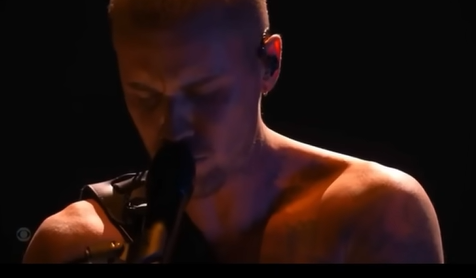 Justin Bieber performing at 2026 Grammys
The Heat of the Light
The first thing you notice is the colour. That deep, cinematic red — the kind used in Neo Noir to signal danger, desire, confession — sets the emotional temperature instantly. Rather than flattering him, it sharpened the moment. Under that light, Bieber looked less like a pop star and more like a man caught in the act of becoming. Because of that, the moment felt alive, almost uncomfortable, as if we were witnessing something private.
Performance Without Armour
There was no choreography, no spectacle, no protective layer. Instead, the performance relied on breath, voice, and the tremor of someone who hasn’t yet decided whether to retreat or step forward. The simplicity wasn’t aesthetic minimalism; it was emotional minimalism — a refusal to hide behind production. In that stillness, every micro‑expression mattered, and every inhale felt like a choice.
The Quiet Reclamation
There’s also a deeper layer here, one that doesn’t need to be dissected to be felt. Bieber grew up inside an industry that often treated him as a commodity rather than a child, and the shadows of that history don’t simply disappear. Even so, what made his 2026 Grammys appearance so striking was the way he stood in that light not as a wounded boy but as a grown man choosing vulnerability on his own terms. The tenderness in his voice, the steadiness in his posture, the way he sang toward his wife — all of it suggested a reclamation. It wasn’t a reenactment of past harm; it was a quiet declaration of who he has become, and who he loves.
Why It Felt So Human
In the weeks since the show, the conversation has circled everything except the thing that mattered most: the sincerity. We’re used to performances polished into oblivion, where emotion becomes a product rather than a presence. Bieber disrupted that expectation. Instead of performing at the audience, he performed from something — a place of conflict, tenderness, and unguarded truth. Consequently, the moment lingers. It wasn’t entertainment. It was exposure.
The Cultural Inconvenience of Vulnerability
We live in a time where vulnerability is often packaged, curated, and sold back to us as content. However, real vulnerability — the kind that shakes, the kind that risks misunderstanding — is culturally inconvenient. It doesn’t fit neatly into narratives of comeback or scandal. Bieber’s performance resisted narrative entirely. Instead, it asked the audience to feel rather than consume, and that’s a harder ask than it sounds.
Craft, Collaboration, and Emotional Engineering
What looked like stark simplicity onstage emerged from a team that understands Bieber’s emotional register better than anyone. Executive producer Ben Winston, who oversaw the broadcast, described the lead‑up to the performance as intentionally loose — decisions made late, space left open, nothing over‑designed. That looseness wasn’t a lack of preparation; it was a philosophy. As a result, the conditions were set for something unrepeatable, something that couldn’t be rehearsed into submission.
Bieber’s longtime musical director Bernard “Harv” Harvey has always built arrangements that protect the emotional core of a song, and the Grammys version of “Yukon” carried his fingerprints: a skeletal structure, a pulse that felt like breath, instrumentation that refused to compete with the human being at the center. Creative director Nick DeMoura, who has shaped Bieber’s live presence for over a decade, has a gift for framing without enclosing. The staging here — stillness, shadow, a single plane of red — reflected that instinct. It wasn’t choreography; it was containment, a frame strong enough to hold a moment of truth.
Even without public commentary from a vocal director or lighting engineer, the craft was unmistakable. The lighting design acted less as illumination and more as emotional temperature — that unwavering red turning the stage into a psychological interior. Meanwhile, the vocal approach, intimate and trembling at the edges, revealed a team that knew exactly when to step back. Their work didn’t build a spectacle; it removed everything that might dilute the sincerity.
This is the quiet genius of collaboration at its highest level: the engineering of a moment that feels unengineered. A performance that looks bare because every unnecessary element has been stripped away. A man standing in the light, supported by people who understand that the most radical thing they can do is let him be seen.
The Lyrical Architecture of “Yukon”
What makes the choice of “Yukon” so striking is how closely its emotional architecture mirrors the performance itself. The song is a declaration of steadiness — a man acknowledging the person who anchors him when the world tilts. Lines like “You’re the reason I’m steady” land differently when sung in a wash of red light, without movement or spectacle to soften them. In that setting, the lyrics feel less like pop songwriting and more like testimony. “Yukon” isn’t about escape; it’s about orientation. It’s a love song that names its centre, and on that stage, Bieber sang it as if he were standing exactly where he meant to be.
“Yukon” is a song about devotion, grounding, and the stabilising force of love — a man naming the person who steadies him when the world tilts. It isn’t built for spectacle; it’s built for presence. The emotional spine is simple and disarming:
- I’ve been through chaos, fame, noise — but you are the constant.
- You steady me.
- You are the reason I can breathe again.
You’re the reason I’m steady.
A Moment that Endured
What unfolded on that stage was pure and heartfelt. The glossy façade of the Grammys fell away as a lone young man bared his heart under searing red light. Bieber stood unguarded, offering presence instead of polish. In a culture addicted to heavily engineered perfection, the raw honesty of the moment felt disarming — and deeply endearing.