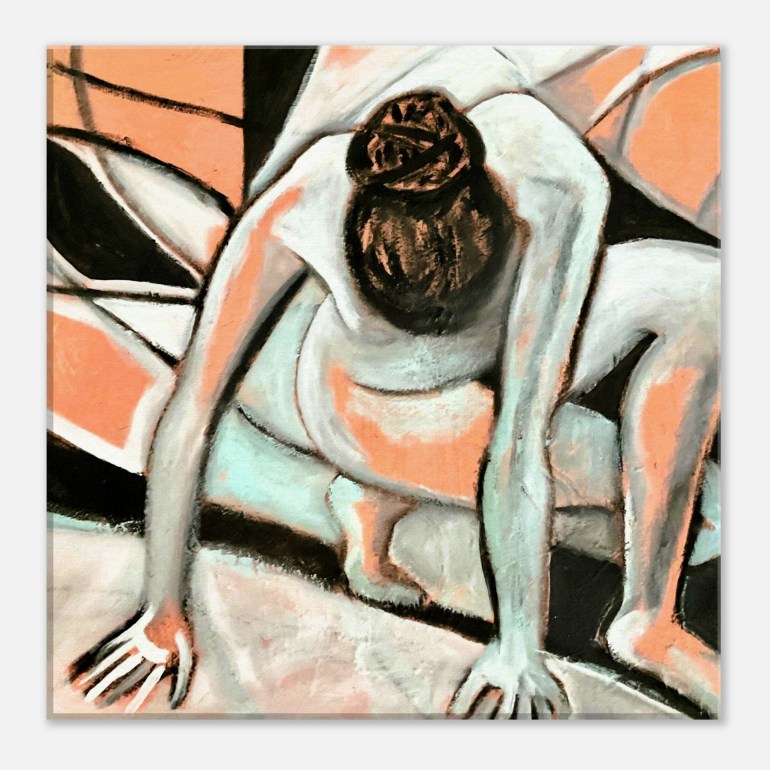
Back to Life is a muted revival. A nude shaped through soft cubism, she carries both absence and return. She arrived slowly — fragmented, softened, almost slipping from memory. I drew her in pieces, letting the geometry breathe between lines. Her contours blur, yet her presence is intentional. She isn’t posed; she’s placed, like memory finding its form again.
Soft Cubism and Emotional Geometry
Soft cubism allows feeling to move through structure. Unlike analytic cubism, which dissects form, this approach distills it — reducing the figure to essentials while preserving its emotional core. Its lineage runs through the Metropolitan Museum’s writing on Cubism, where Braque and Picasso fractured reality into planes, and through Cubism and the Trompe l’Oeil Tradition, which explores illusion, layering, and the quiet defiance of form.
Figure as Element, Not Ornament
In Back to Life, the solitary female figure feels strong and grounded — her body built from softened angles and tonal restraint. She is elemental, like stone warmed by skin. The geometry doesn’t obscure her; it heightens her presence. She stands alone without loneliness, holding space rather than seeking it.
Born in Silence
This piece emerged in the hush between projects, when the studio felt more like a waiting room than a workspace. I wasn’t chasing clarity; I was listening for it. Back to Life appeared not as an answer, but as a presence — a figure returning with weight rather than noise. She belongs in quiet interiors, spaces that honour pause, texture, and emotional resonance.