

Opening Frame
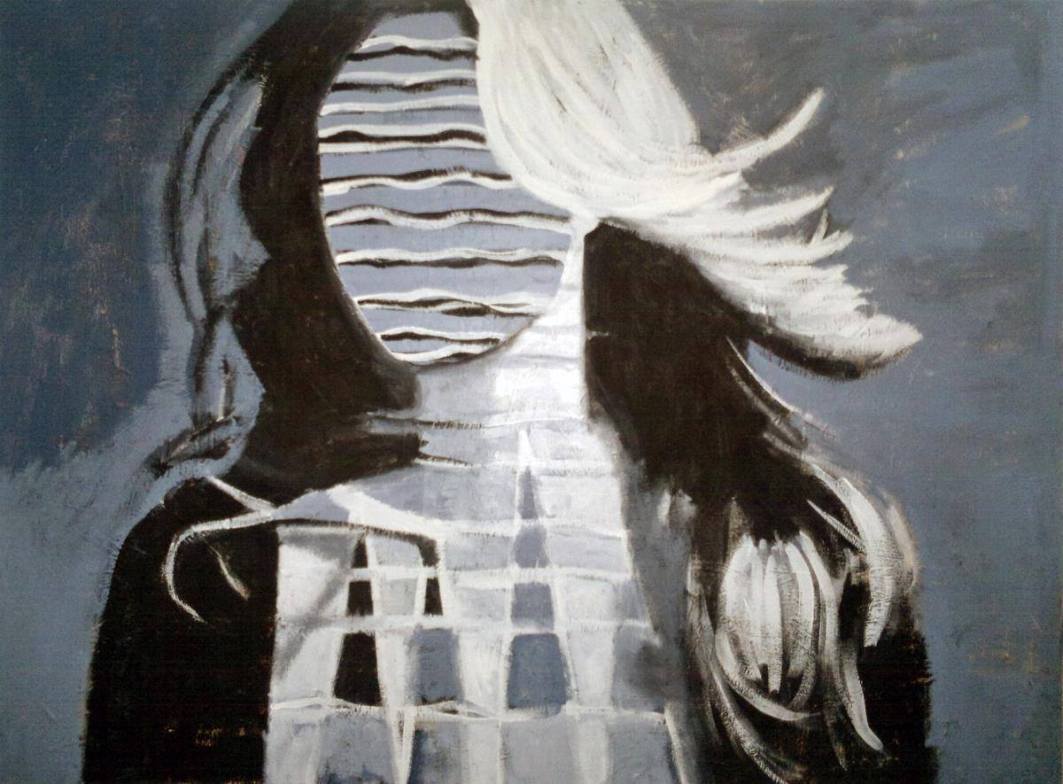
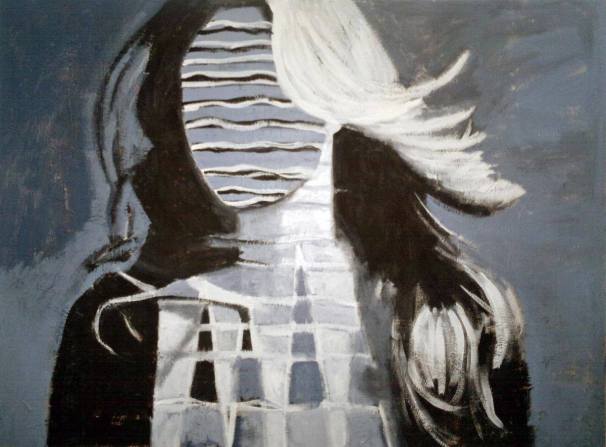
Lee Wilde’s I Saw the Sines transforms the portrait into a field of geometric abstraction — a meditation on perception and identity rendered through rhythm and distortion. The figure’s face dissolves into wave‑like lines, turning recognition into vibration. What begins as a portrait becomes a study of signal and silence, where geometry replaces expression and pattern becomes voice.
Formal Analysis
The composition merges organic gesture with structural logic. Horizontal sine‑waves ripple across the face, while the body is articulated through a grid of pale rectangles. Wilde’s palette — graphite, ivory, and muted blue — evokes both photographic memory and architectural blueprint. The brushwork oscillates between precision and blur, creating tension between control and flux. The painting’s geometry feels alive, as if emotion were measured in frequencies rather than features.
Emotional Temperature
Despite its abstraction, the work carries a quiet intimacy. The absence of facial detail invites projection; the viewer completes what is missing. The waves suggest thought, breath, or transmission — a pulse of consciousness beneath the surface. The emotional temperature is cool yet resonant, like static charged with memory.
Contextual Placement
Within Wilde’s practice, I Saw the Sines extends her exploration of figurative dissolution. It bridges her noir‑inflected realism with the language of geometric abstraction, revealing how structure can hold emotion without depiction. The painting reads as both portrait and code — a translation of human presence into pattern.
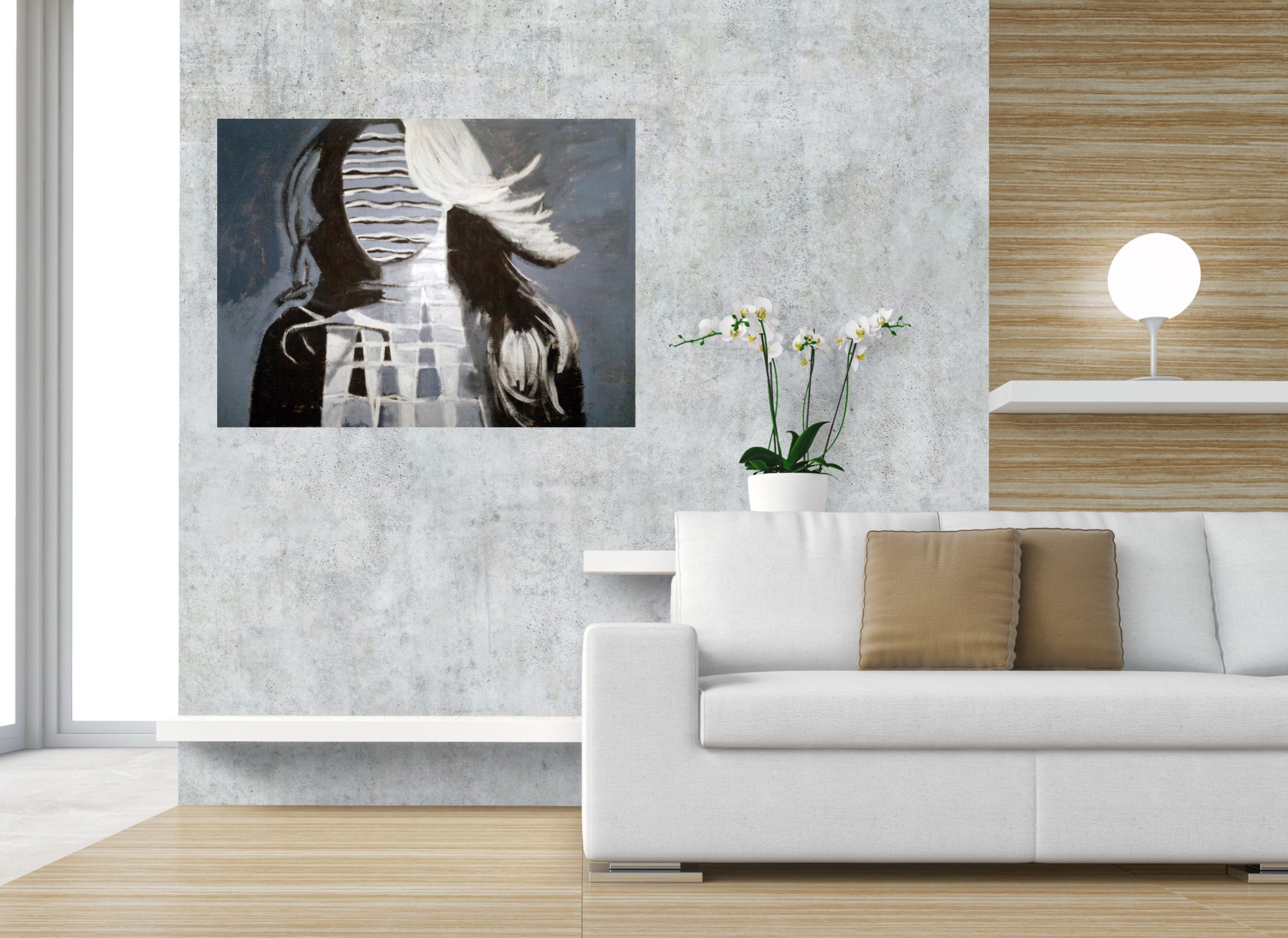 I Saw the Sines – Placed above a minimal sofa line, the piece anchors the room without overwhelming its geometry.
Design Literacy
Designers respond to this piece for its tonal restraint and architectural rhythm. The interplay of line and grid lends it spatial intelligence, making it ideal for interiors that value conceptual clarity and visual calm. It behaves like a soundwave frozen in paint — modern, meditative, and quietly electric.
Collector Note
This artwork has been collected.