

The Series
Director: Marc Cherry Genre: Dark Comedy / Drama
Why Women Kill (2019) is a stylised anthology series created by Marc Cherry, known for his sharp visual wit and layered social commentary. Set across multiple decades, the show examines marriage, privilege, and betrayal through the lens of three women living in the same Pasadena mansion. Each storyline unfolds with heightened glamour and irony, using costume and set design to mirror the emotional architecture of its characters.
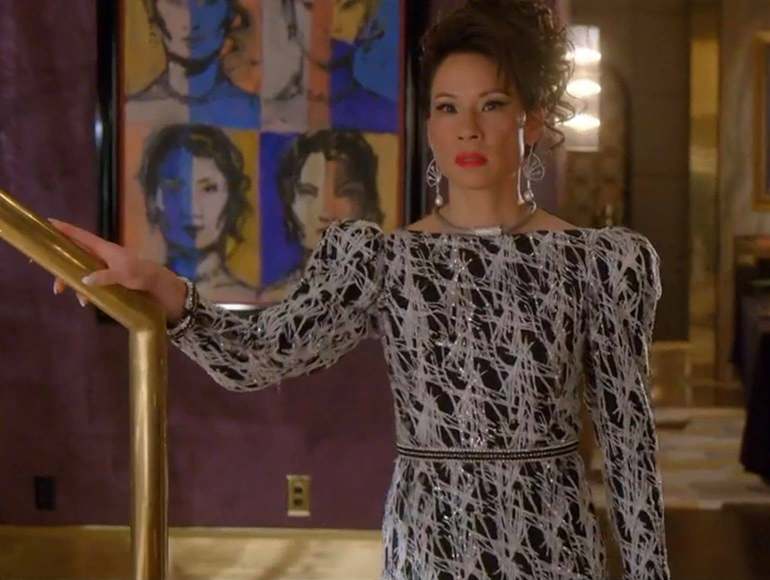
In Season 1, socialite Simone Grove, played by Lucy Liu, inhabits a world of opulence and control — a palette of jewel tones, polished brass, and art‑collector precision. The interiors are as expressive as the dialogue, revealing the contradictions between surface beauty and emotional chaos.
The Artwork
Artwork: Untitled Portrait Series Artist: Manolo Valdés Movement: Contemporary Figurative / Neo‑Pop
Spanish artist Manolo Valdés is celebrated for his reinterpretations of classical portraiture through modern materials and repetition. His work often merges figuration with abstraction, using bold colour blocks and layered textures to evoke memory and identity. The piece seen behind Simone Grove — a grid of stylised female faces rendered in blue, orange, and yellow — exemplifies Valdés’s fascination with the iconography of women in art history and media.
Scene Context
In one of Simone’s most visually charged scenes, she descends a staircase in a black‑and‑white patterned gown, framed by the saturated hues of Valdés’s portrait series. The composition is deliberate: her dress echoes the painting’s graphic rhythm, while the gold railing and violet wall heighten the sense of theatrical luxury.
The camera captures a moment of poised tension — Simone’s elegance set against the fractured repetition of faces behind her. It’s a tableau of identity and performance, where art becomes a mirror for the character’s own self‑presentation.
Why this Painting?
Valdés’s work amplifies the show’s central themes of appearance, multiplicity, and reinvention. The repeated female faces behind Simone suggest the many versions of womanhood she performs — socialite, wife, lover, survivor. The painting’s divided colour fields echo her emotional fragmentation, while its pop‑art sensibility underscores the performative nature of her world.
Placed within the frame, the artwork becomes a silent commentator on Simone’s duality: poised yet conflicted, decorative yet deeply human.
The Cinematic Function
Visually, the Valdés painting stabilises and complicates the scene at once. Its grid structure introduces order, while its expressive brushwork injects movement and psychological depth. The interplay between Simone’s patterned gown and the painting’s chromatic geometry creates a dialogue between fashion and fine art, surface and substance.
It’s a moment where television borrows the semiotics of gallery art to enrich character and atmosphere — proof that even in stylised drama, visual culture remains a powerful narrative language.