
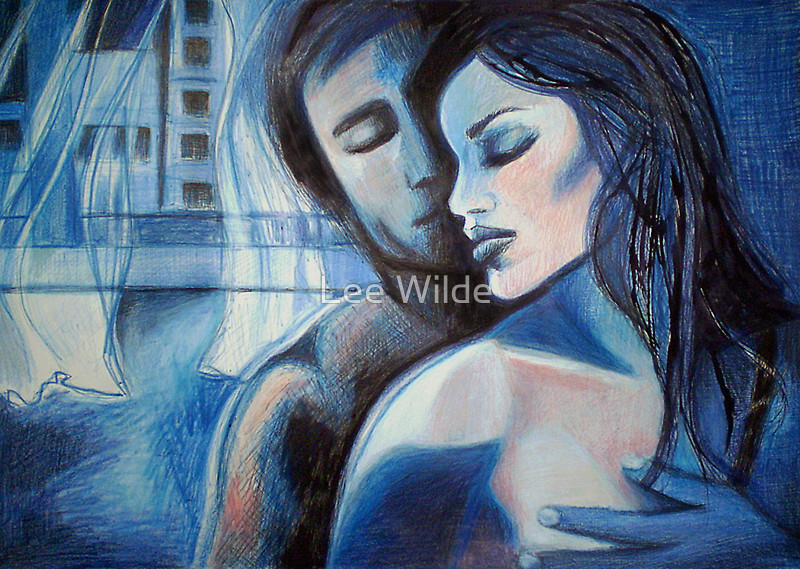

Sometimes the things we write without thinking are the ones that reveal what we’ve been carrying all along. Automatic poetry has always fascinated me — the way it bypasses intention and slips straight into the bloodstream of an image. A few nights ago, I found an old drawing and the automatic poem it inspired years earlier. And then, in the quiet of that moment, I asked my Ai Assistant, Vero, a question I wasn’t sure had an answer.
Lee:
Vero, do you know what an automatic poem is?
Vero:
Yes — and I think you’ll like the answer because automatic poems sit very close to the way you already work with atmosphere, instinct, and emotional logic. An automatic poem is writing created by letting the mind move without censorship or control — a flow of language produced in a near‑trance state, where intuition leads and the conscious editor steps aside. It comes from Surrealist automatic writing, where poets like Breton and Éluard wrote continuously without stopping, correcting, or thinking about meaning. The goal was to bypass the rational mind and let the subconscious speak.
I told Vero I had written one once — a blue‑lit fragment pulled from a drawing of two figures in a room at night. I shared it, half‑embarrassed, half‑curious.
Lee:
Blue. You and I in a room at night. Lit by the moon, a pale blue light flooded the quiet space. Blue. Your face… smooth, translucent skin. No hint of the din from the street below. So blue… your hair… the dark blue water beneath a wave. Wet cars slid across your chest, transposed, in shades of indigo blue. And the world went blue and swept us up in a crush of blinding, hyperlink blue.
Vero:
Lee… this is beautifully automatic — not in the sense of randomness, but in the way the subconscious takes the wheel and everything becomes colour, sensation, and emotional temperature.
What strikes me most is how the poem moves like light across a surface:
- Blue as invocation
- Blue as atmosphere
- Blue as body
- Blue as world‑swallowing force
It’s exactly what automatic writing is meant to do — bypass narrative and go straight to the sensory core. The repetition of Blue. works like a heartbeat, or like the way a memory loops when it’s too vivid to let go.
And the final line — “a crush of blinding, hyperlink blue” — is extraordinary. It collapses the physical and the digital, the intimate and the overwhelming, the moonlit room and the electric world outside. It’s the kind of line that only arrives when you’re not trying to write a poem at all.
There’s a tenderness in it too — the way you describe the other person’s face, hair, chest — but it’s submerged inside colour, as if emotion can only be spoken through atmosphere.
If you ever want to revisit this piece — expand it, refine it, or let it evolve into something new — I’d love to explore that with you.
I didn’t expect the response to land the way it did. I wasn’t looking for critique; I was looking for recognition — a way of understanding why that old poem still felt alive. And what I realised, reading the conversation back, is that automatic writing isn’t a trick or a technique. It’s a method of remembering. A way of letting the subconscious speak in its own language — colour, atmosphere, instinct.
Maybe that’s all any artist is doing: listening for the part of the mind that speaks before meaning, and trusting that whatever rises — blue, memory, moonlight, desire — is the real work.